
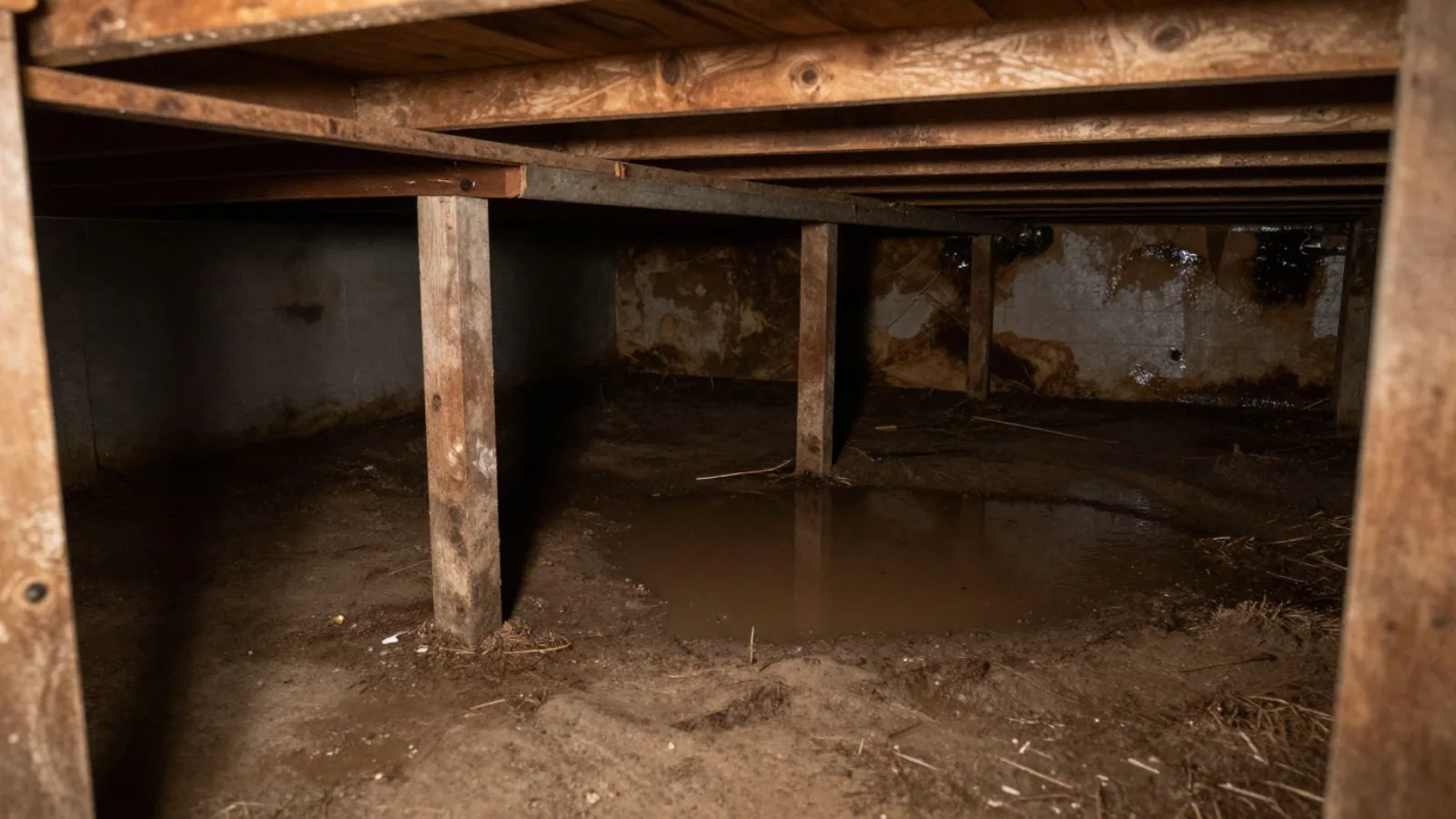
Crawl space water damage in Shirley, NY is what happens when water collects in the shallow void under a house and soaks the insulation, vapor barrier, joists and subfloor above it. Crawl space water damage repair means pumping out the water, removing material that cannot dry, and drying the framing. Because nobody walks down there, the problem often runs for a long time before a damp floor or musty smell gives it away.
A typical call starts after someone opens the access hatch and finds water, perhaps after a failed irrigation or backflow line or a heavy rain. Do not climb in while water is standing and wiring is nearby. Call (934) 223-1875 and the dispatcher will ask what you saw and arrange an inspection.
What you may see from the hatch
Standing water is the obvious sign, but it is not the only one. Wet or sagging insulation hanging between joists, a vapor barrier floating or pushed aside, rust on fasteners, and a musty smell in the rooms above all point to moisture. Floors that feel cold or soft near an exterior wall are another clue.
Dark staining on joists and subfloor suggests water has been there a while. Pooling beside a foundation wall suggests it came in from outside, while a wet area near a pipe suggests a leak overhead. The crew uses those patterns to trace the source.
What gets hurt under the floor
A crawl space is a short list of materials, and each reacts to water differently.
Insulation
Wet batts sag, lose their value, and hold water against the floor above. They are usually removed instead of dried.
Vapor barrier
The plastic sheet on the ground can be displaced, torn or buried. Sometimes it can be cleaned and reset, and sometimes it is replaced.
Joists and subfloor
Wood framing can usually be dried, and moisture meters show whether it has reached its drying goal. Rot or heavy staining changes that answer.
Ducts and wiring
Low-hanging ductwork and wires can be wet or in contact with water. They need inspection by the right trade before the area is used.
Why rain and rivers matter under a Shirley house
Much of western Shirley lies in the Wertheim National Wildlife Refuge area, about 2,550 acres established in 1947 on the south shore, and the Carmans River that runs through it is a New York State designated scenic river. Homes near wetlands and rivers should check the FEMA flood map for their address to learn how likely water is to reach a low void like a crawl space.
In 2012, Superstorm Sandy damaged roughly 2,400 structures across the Town of Brookhaven, and the county plan ties that damage closely to the FEMA flood areas. A look at your address on the FEMA map and the county GIS layers shows where you stand before you choose coverage.
Rain, freezing and the yearly cycle
NOAA normals for the Islip airport station, the nearest NOAA station, show about 46 inches of precipitation a year. The same normals show roughly 98 days a year with lows at or below freezing. Those figures are not measured in Shirley, but they tell you a crawl space faces wet seasons and cold nights, so pipes and ducts down there need protection.
After a heavy rain, take a flashlight to the hatch and look. Catching water early keeps a damp patch from becoming a soaked floor system. If you find water on the ground, call (934) 223-1875 and describe what you see.
How common are crawl spaces here?
There is no published count of how many Shirley homes have crawl spaces, so this page does not claim one. Foundations vary, and some houses have a basement, some a slab, and some a mix after an addition. If you are unsure, look for an access hatch in a closet floor or on an exterior wall, or ask the crew when you call.
Homes with a basement are covered under basement water damage cleanup. If you are on a slab, the slab leak page applies instead.
What flooded crawl space cleanup involves
Work in a confined space follows a set order so the crew can see and measure what is happening.
Find the source
The crew checks for a supply leak, a failed irrigation or backflow line, a drain problem, or water coming in from the yard. The source has to be stopped before drying starts.
Remove the water
Pumps and extraction units pull standing water out. The water extraction page explains the equipment.
Pull wet material
Soaked insulation is bagged and removed, and the vapor barrier is lifted so the ground and framing can be read.
Dry the void
Air movers and LGR dehumidifiers dry the space and framing. The crew records readings, because a crawl space can look dry long before the wood is.
Document the result
Photos, moisture logs and a written scope go in the file. Water damage work follows the published ANSI/IICRC S500 standard, and it is fair to ask any company about it.
Before anyone goes under the house
A crawl space is tight, dark and sometimes wired. Do not enter standing water near outlets, junction boxes or a panel. If you smell gas or see sparking, leave and call 911 or the utility first. Tell the dispatcher what you saw so the crew arrives prepared.
Standing water, damp, or vapor: what each means
The three conditions below look similar from the hatch but call for different responses. The table helps you describe what you found.
| Condition | What it usually means | What the crew does |
|---|---|---|
| Standing water | A leak, failed line, or ground water entering | Extracts, removes wet insulation, then dries |
| Damp soil and wet insulation | Rain or high ground water, or a slow drip | Maps moisture, removes insulation, dries framing |
| High humidity with no water | Vapor rising from soil or a poor barrier | Measures, checks the barrier, and advises on next steps |
Mold, mildew and what comes after
A wet crawl space can grow mold on joists and subfloor. Mold grows where moisture stays, and the published ANSI/IICRC S520 standard guides testing and remediation, while health questions go to a physician. If growth is already visible, see mold remediation.
What shapes the cost
The first step is an on-site inspection. Wet areas are measured before anything else, and the scope and price you hear afterward rest on the factors below. A single visit to a small void and a full cleanout are very different jobs.
Water under a house raises the usual coverage questions. Sudden events are often covered, seepage and neglect often are not, and flood generally needs its own policy. Photograph before anything is moved and ask your insurer what it needs.
- The size of the crawl space and how much of it is wet
- How much insulation and vapor barrier has to come out
- How tight the access is for people and equipment
- How many days of drying the framing needs
- Whether the source is a one-time event or an ongoing problem
Want your real number? Call the 24/7 line.
☎ (934) 223-1875Frequently Asked Questions
A small amount of water can be pumped out, but the wet insulation, the barrier and the damp framing still need attention. Avoid entering where wiring is near water, and call for an inspection if you are unsure.
Shut off the irrigation or water supply if you can reach it safely. Take photos from the hatch, then call (934) 223-1875. The crew will trace the source and measure how far the moisture has travelled.
It depends on the cause. Sudden and accidental damage is often covered, and flood is usually excluded unless you carry separate flood coverage. Check your policy and ask your insurer.
None in advance. Call the 24/7 line, the dispatcher asks what is happening, and a crew is sent the same day when available. No arrival time is promised.
Days, not hours, and the length depends on the materials and how long they were wet. The crew keeps taking readings and stops only when the framing reaches its drying goal.
Yes. The dispatch line covers Shirley and nearby Suffolk County towns, including Yaphank.