
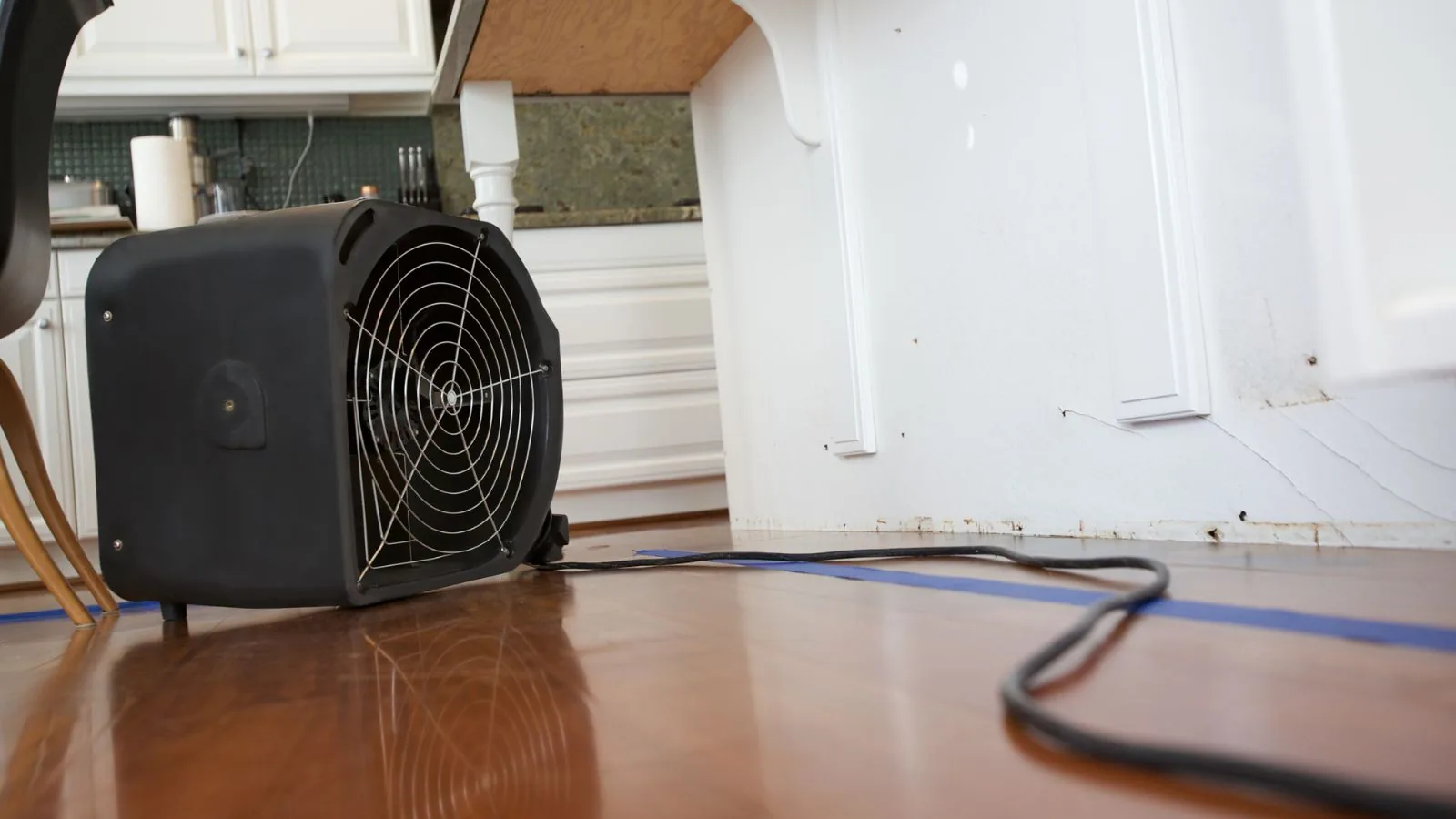
Kitchen water damage restoration in Shirley, NY is the work of tracing where water went around the sink, the dishwasher line and the cabinet boxes, drying what can be dried, and removing what cannot. Water in a kitchen rarely stays where it started. It runs along the cabinet floor, wicks up the sides of particleboard, and settles under the toe kick where nobody looks.
If the sink base smells damp or a cabinet door no longer closes square, call (934) 223-1875. The dispatch line sends restoration professionals who read moisture levels before anyone pulls out a cabinet. For a dishwasher or refrigerator line that failed outright, see appliance leak cleanup, since that job starts with the machine.
Why a kitchen holds water longer than other rooms
A kitchen packs a lot of absorbent material into a small footprint. Cabinet boxes are often particleboard, which swells when wet and does not shrink back. The toe kick, the base shelf and the back wall of the sink cabinet sit in a pocket with almost no airflow, so moisture lingers long after the surface feels dry.
The Shirley area was developed from the 1940s on small lots, and many homes here are older and compact. In a tight kitchen the cabinets sit close to the walls and appliances, so one leak reaches several surfaces fast. After any leak, ask the crew to check the supply lines, shutoff valves and wiring near the sink, because older fittings deserve a look.
Signs the cabinets are taking on water
Kitchen damage shows itself low and at the edges first. Check the bottom of each cabinet face and look inside the base units.
- Doors or drawers that rub, stick or no longer line up
- Paint or laminate lifting at the bottom edge of a cabinet face
- A toe kick that feels soft or crumbly when you press it with a thumb
- Dark rings or stains on the cabinet floor under the sink
- A musty smell the moment you open the sink base
- Countertop edges that lift where the sink or backsplash meets them
Any one of these is enough to shut the valves under the sink and call. Wiping the surface tells you nothing about what the back of the cabinet is holding.
Water damage under the kitchen sink: slow leaks and fast ones
The sink base is where most kitchen leaks begin, and the two kinds behave differently.
The slow drip
A weeping slip nut, a worn faucet supply or a loose trap can wet the cabinet floor for weeks before a stain appears. By the time you see it, the base is often swollen and the wall behind the cabinet may be damp as well. Slow leaks are the ones that end in a larger tear-out than anyone expected.
The fast leak
A loose dishwasher hose or a cracked disposal housing can flood the cabinet and the floor in a short time. Close the valve, pick up the standing water, and leave the cabinet doors open so air can reach the inside. Then call, because the water that soaked into the base and the floor edge is still there.
How the crew works through a wet kitchen
The order matters. Drying before finding the source just repeats the problem.
Confirm the source is stopped
The crew checks the shutoff valves and the supply and drain connections so no new water enters while drying starts.
Map the moisture
A moisture meter reads cabinet sides, toe kicks, subfloor edges and the wall behind. A thermal imaging camera shows cool, wet areas through paint and tile that a meter cannot reach.
Remove what is past saving
Swollen particleboard, soaked insulation and ruined flooring edges come out. Solid wood and plywood boxes are often dried in place instead.
Open the cavities
Toe kick boards come off and small openings may be cut behind a cabinet so air can move through the pocket.
Dry with air movers and a dehumidifier
Air movers push air along the cabinet floor and into the wall while an LGR dehumidifier pulls moisture out of the room. Readings are logged each visit until the materials reach a dry standard.
Write the rebuild scope
A written scope lists what to replace, such as a base cabinet or a countertop section, so a contractor can price the rebuild.
Which cabinet parts can be saved
Materials decide most of the outcome. This table is a rough guide, and the crew's readings settle each case.
| Part | What water does | Usual result |
|---|---|---|
| Solid wood box | Swells a little, then dries back | Often dried in place |
| Plywood box | Edges separate if soaked for long | Dry fast, or replace the base |
| Particleboard box | Swells and crumbles | Usually replaced |
| Toe kick | Soaks up from the floor | Often removed and replaced |
| Laminate countertop edge | Lifts at the seam over wet wood | Replace the section |
| Stone or solid surface top | Water itself does not harm it | Detached and reset if cabinets below come out |
Detaching a countertop adds labor, which is one reason a wet sink base can cost more than it first looks. The written scope shows where that labor comes from.
Outlets, lighting and the dishwasher circuit
Kitchens have outlets at counter height, under-cabinet lighting, and a dishwasher or disposal wired close to the sink. If water has reached any of them, do not touch them or stand in water. Turn off power to the wet area only if you can reach the panel while dry, and otherwise call and wait.
Know your water supply before anyone flushes the lines
Much of Suffolk County gets public water from the Suffolk County Water Authority, and many homes use a private well instead. Tell the crew which you have, because a well pump and treatment equipment change what is safe to run after a leak. A private well is a matter for the Suffolk County Department of Health Services.
The same call is worth making if the leak ran for days. Neighbors in Patchogue read through the Patchogue service page for how the dispatch line covers their area, and the process is the same.
What shapes the cost of kitchen work
Price follows what the water touched, not the size of the room. A sudden failure at the sink, dishwasher or supply line is often covered, while a slow leak under cabinets often is not, and flood is usually excluded. Read the policy, ask your insurer, and hand over the crew's photos and readings.
Assessment comes first, and work follows. After the crew looks things over and takes readings, the scope and pricing are explained ahead of any work and follow from the factors here.
- How many cabinet boxes are wet and what they are made of
- Whether the water reached the subfloor or the wall cavity behind the cabinets
- How long the leak ran before it was found
- Whether a countertop must be detached and reset
- How many days of drying equipment the readings call for
Want your real number? Call the 24/7 line.
☎ (934) 223-1875Frequently Asked Questions
Press the cabinet floor and toe kick with a thumb. If it feels soft, crumbles or has swollen at the edges, the particleboard has taken water. A moisture meter gives the real answer, and solid wood or plywood boxes can often be dried and kept.
Sometimes. Swollen particleboard usually cannot return to its shape, but plywood and solid wood often can if drying starts quickly. The crew tests each box and tells you which ones to keep.
Close the shutoff valves under the sink, or the main water valve if they will not turn. Empty the cabinet, pick up standing water, and leave the doors open. Take photos before you move anything, then call (934) 223-1875.
Mold needs moisture, and the pocket behind a cabinet stays wet longer than most places. Fast drying removes that moisture. If you already see spots or smell mustiness, read about mold remediation. Questions about health belong to a physician.
Not always. Stone and solid surface tops can stay if the cabinets below dry in place. If base cabinets must be removed, the top is detached and usually reset, which adds labor.
The wet cabinets, floor edge and toe kick are handled here. The failed machine, hose or supply line is covered on the appliance leak page, and the two jobs often happen together.
None. Call (934) 223-1875 whenever the damage is found. After a few questions about the damage, the dispatcher schedules a crew, same day when available. The dispatcher cannot promise when you will be reached, since call volume and the roads decide it.