
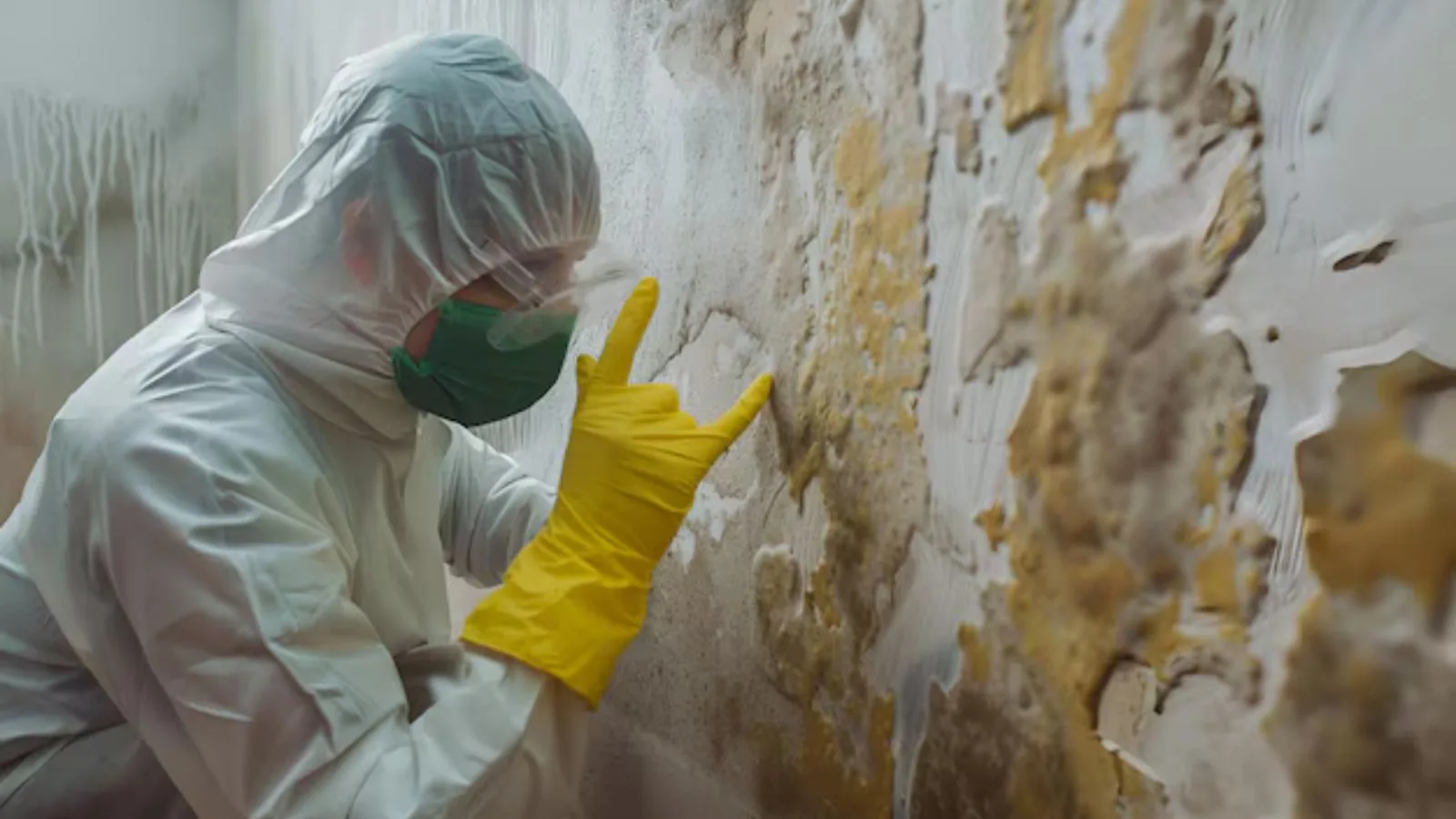
Mold remediation in Shirley, NY is the controlled removal of mold growth and the moisture that fed it, done to a written plan and checked afterward. Mold needs moisture to grow, so cleaning without fixing the water source only buys a short pause. This page explains what happens, who is allowed to do it, and what you can and cannot do yourself.
If you want to talk through what you are seeing, call (934) 223-1875. The dispatch line is open 24/7, the dispatcher asks what is happening, and a crew or assessor visit is arranged the same day when available. No arrival time is promised, and no notice is needed before you call.
A musty smell, spots that return, stains after a leak
These are the three things people call about most. A smell with no visible source, black or green spots that come back a week after you wipe them, or a brown patch left behind by an old leak all point to moisture that never fully dried. The trade that deals with it is called mold remediation, and it starts with an assessment, not a spray bottle.
Mold after a leak: the water comes first
Every mold problem has a moisture story. A toilet seal, a sink supply, a dripping air conditioner condensate line, a roof leak or a gap in siding can each wet a wall for weeks. Until that leak is fixed, nothing that follows will hold.
Ceiling stains below a bathroom or roof point to ceiling water damage repair first. A line that drips from an air handler is covered on the AC leak page. Once the source is stopped, the wet materials must be brought to a dry reading, which is the job of structural drying and dehumidification. Mold work comes after the water problem is under control.
Small spots in closets, bathrooms and behind furniture
Mold often hides where air does not move. Look at the back of a closet along an outside wall, the ceiling corner above a shower, the wall behind a couch or dresser, and the underside of a carpet that was pulled up after a spill. Spots in those places tend to be small, but they sit on materials that stay damp.
A small area can be a homeowner job. New York defines a mold project as more than ten square feet, and a homeowner working on their own residential property is exempt from the licensing rules.
For a small area on a hard surface, the steps that matter are fixing the moisture, wearing a fitted respirator and gloves, wiping with a detergent solution, and drying the surface completely. Do not mix cleaning products, and stop if the growth is larger than it looked or is inside the wall.
Who can do the work in New York
The New York State Department of Labor runs a mold program. Mold assessors, mold remediation contractors and mold abatement workers must be licensed. This table shows how the rules play out for a homeowner.
| Situation | Who does the work | What to know |
|---|---|---|
| Ten square feet or less, your own home | You, as the owner | Below the state definition of a mold project. Fix the moisture first |
| More than ten square feet, your own home | The owner is exempt, but many choose a licensed contractor | The exemption covers work on your own residential property only |
| More than ten square feet, any other case | A licensed assessor and a separate licensed remediation contractor | The assessor writes the plan, the contractor follows it |
| After the removal on a mold project | The licensed assessor who wrote the plan | Post-remediation assessment checks the result |
The same individual may not do both the assessment and the remediation on the same project. Ask any mold company for its New York license and ask who is doing the assessment.
Inspection and testing: what they can and cannot tell you
An assessment is a licensed person looking at the building, finding the moisture source, mapping the affected area and writing a remediation plan. Sampling can show whether spores in the air or on a surface are higher than outdoors. Testing cannot tell you whether anyone's health is affected, and it cannot tell you how long the mold has been there. Health questions belong to a physician.
Can someone just look at it? A visual check helps, and a thermal imaging camera and moisture meter find wet areas that the eye cannot see. But only a licensed assessor can write the plan on a mold project. Because the assessor and the contractor must be different people, the assessor has no stake in a larger job.
What S520 means and what it does not
ANSI/IICRC S520 is a published industry standard for mold remediation. It describes containment, air filtration, removal methods and how to check a job, and it classifies conditions by how much growth is present. Ask any company whether its crews work to S520. This page does not claim any certification for the crew.
In practice, the standard shows up as plastic containment, negative air with a HEPA air scrubber, HEPA vacuuming of surfaces and removal of porous materials in sealed bags. Surface cleaning of non-porous materials follows. The point of the setup is to keep spores from spreading to clean rooms while the work is done.
What can stay and what gets removed
The question is whether a material is porous, because mold roots into porous surfaces and sits on non-porous ones.
| Material type | Examples | Usual outcome |
|---|---|---|
| Non-porous | Glass, metal, glazed tile, hard plastic | Cleaned and kept |
| Semi-porous | Sealed wood framing, concrete | Cleaned, sometimes sanded or abrasively cleaned, and kept |
| Porous | Drywall, ceiling tile, insulation, carpet and pad | Usually removed and discarded |
| Soft goods and paper | Clothing, upholstery, books | Cleaned if lightly affected, otherwise discarded |
The assessor's plan decides each item. A wall that looks fine can still be opened if readings show moisture inside.
Black mold removal and what to do about it
Black mold is a popular name, and color does not tell you what the growth is. Dark spots can be one of several organisms, or soot, dirt or a stain. Only sampling by a licensed assessor identifies it, and the removal method is the same either way: fix the water, contain, remove and dry.
If you ask how to remove black mold yourself, the honest answer depends on size. A few square inches on a tile wall can be wiped with detergent and dried. A patch on drywall or growth across a larger area is a reason to call a licensed assessor.
Crawl space mold and damp lower levels
Crawl spaces and basements hold humid air and have little airflow. Mold on joists, insulation or the subfloor above a crawl space is a regular reason for an assessment, and the crawl space water damage page covers the water side. The plan usually includes fixing the entry of water, drying and then removal.
The nearest NOAA station, at Islip airport, averages about 46 inches of precipitation a year in its normals. Ask your assessor to check humidity as well as visible growth.
Clearance testing for a home sale or a loan
Clearance testing is the post-remediation assessment. After removal, the licensed assessor who wrote the plan checks that the work met it, using a visual check and sometimes samples. A buyer, a lender or an insurer may ask for it, and each decides what it accepts.
A lender may require mold removal before it funds a loan, but nothing here promises what any lender or buyer will accept. Ask the lender what paperwork it needs before work starts, so the assessor knows what the plan must cover. Keep the written plan and the final assessment together.
Serving nearby towns
The dispatch line covers Shirley and nearby Suffolk County towns. Neighbors in Yaphank can read the Yaphank page for how local service works, and the mold process is the same. Tell the dispatcher what you see and where.
What shapes the cost of mold remediation
No exact quote can be given without an assessment. Mold cost depends on the factors below, and two rooms that look alike can differ a lot. Coverage depends on the policy and the cause, since sudden and accidental water damage is often covered while gradual leaks and neglect often are not. Check your policy or ask your insurer.
Before any work, the damage gets inspected. You get scope and pricing in plain words before work starts, once readings are in, and the factors here drive both.
- The size of the affected area and how many rooms it reaches
- Whether growth is on surfaces or inside walls, ceilings or floors
- The amount of porous material that must be removed and rebuilt
- Containment and air filtration needed to protect other rooms
- Assessment, plan and post-remediation assessment by a licensed assessor
Want your real number? Call the 24/7 line.
☎ (934) 223-1875Frequently Asked Questions
Spots that return usually mean moisture is still present, either inside the wall or in the air. Wiping removes the surface and not the cause. Find the water source, then have a licensed assessor look at the wall before repainting.
You cannot tell by color or by sight. Dirt, soot, stains and mildew can look the same. A licensed assessor, with moisture readings and sampling if needed, can say what it is and how far it goes.
A lender may ask for it, but each lender decides. Clearance is the post-remediation assessment done by the licensed assessor who wrote the plan. Ask the lender what it needs first, and no one can promise what it will accept.
None. Call (934) 223-1875 any time. The dispatcher asks what is happening, and a visit is arranged the same day when available. No arrival time is promised.
On a New York mold project, no. The same individual may not do both the assessment and the remediation. The licensed assessor writes the plan and checks the result, and a licensed contractor does the removal.
No honest company can promise that. Mold returns when moisture returns. Removal plus a fixed leak and a dry structure is how a repeat is avoided.
It depends on the area, the materials, the containment and the assessment. No number can be given without a look. The assessment comes first, and the scope and pricing are explained before work starts.